


Drone-Mounted Gas Sensors
Drone-mounted gas sensors enable inspection of tanks, flares and elevated areas without scaffolding or human exposure. We combine electrochemical, NDIR and PID sensors for VOCs, delivering real-time georeferenced data to locate the source, measure dispersion, compare campaigns and prioritise rapid, safe and fully documented intervention.
The modular payload integrates up to four sensors, records simultaneous readings and sends alerts to a unified platform with configurable thresholds and trend analysis. Wi-Fi/LoRa communication with 4G/5G backup prevents signal loss in EMI-prone areas, stores historical records and generates clear maps for maintenance, environmental control and process safety.

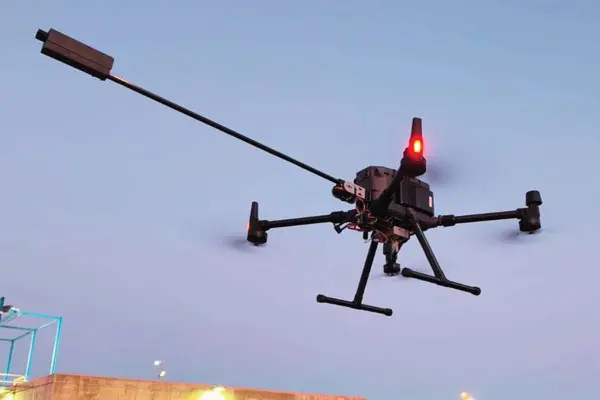
What Do Drone-Mounted Gas Sensors Involve?
We install a detection payload with up to four simultaneous sensors (electrochemical, NDIR and PID for VOCs) configured according to site risk levels. Each reading is georeferenced and synchronised with video and flight path. The operator monitors concentration in real time, adjusts sampling height and performs sweeps or safe close approaches as required.
Missions follow pre-planned routes or ad-hoc investigation guided by concentration peaks and wind direction. The platform visualises plumes and trends, marks thresholds by zone and logs events with timestamp and operator ID. Using Wi-Fi/LoRa with 4G/5G backup, transmission remains stable even in EMI areas, pipe racks and complex metallic structures.
The leak report integrates photos, video, concentration maps, per-second reading tables and flight track data, including RTK coordinates, dispersion estimation, operational notes and prioritised recommendations. If a fixed detector network exists, we fuse data to validate the source and define the perimeter, ensuring traceability and documented maintenance closure.
Benefits of Drone-Mounted Gas Detection
Aerial inspection with integrated sensors reduces exposure, shortens diagnostic time and improves data quality. Georeferenced readings and a unified platform transform signals into decisions, prioritising repairs and documenting incidents.
Active prevention with instant alerts and live maps.
Reduced personnel exposure in elevated or critical zones.
Operational continuity: fewer shutdowns and incidents.
Automated compliance and audit-ready records.
Scalability: fixed + drone integration on a unified platform
Multi-sensor versatility for multiple gases and ranges.
Beyond locating the leak, the multi-sensor approach enables impact assessment and solution verification within the same shift. Integration with fixed detectors and SCADA/CMMS provides documented evidence, accelerates audits and strengthens measurable prevention culture.
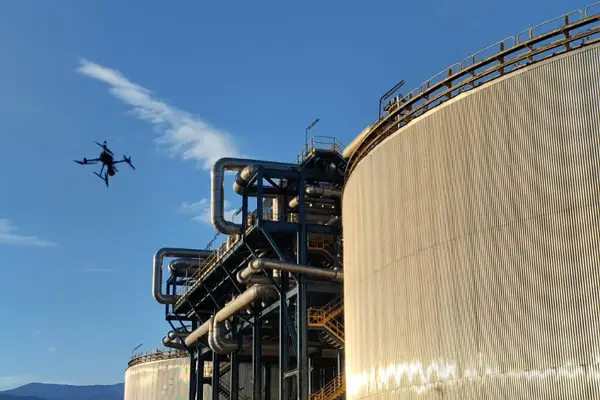
Complementary Services
Applications and scenarios of Drone-Mounted Gas Detection
The combination of drone-mounted sensors and a data platform delivers value in large-scale or elevated assets. We adapt sensor type, range and flight strategy to each risk profile, generating maps and trend analysis that accelerate intervention, prevention and coordination between technical teams.

Why Choose SG solutions gas sensers
RTK-enabled gas detection combined with thermal and industrial methodology. Georeferenced reports delivered in under 48 hours, historical tracking and export to SCADA/CMMS.
Trust Smart Inspection
With live data, alerts and maps, you narrow the focus, reduce exposure and act before incidents occur. Aerial inspection provides speed and traceability to protect people and operational continuity.
Integrate drone-mounted sensors with fixed monitoring networks in a single dashboard, share reports and document every decision. Gain control, accelerate incident resolution and demonstrate compliance during demanding audits.
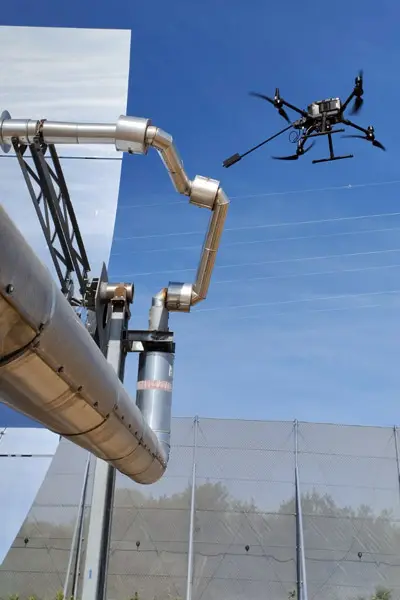
Frequently Asked Questions about Drone-Mounted Gas Sensors
Electrochemical sensors for toxic gases, NDIR for CO/CO₂/CH₄ and PID for VOCs. Up to four sensors can be configured according to site risk.
Individual calibration and field validation. Georeferenced readings, time-stamped records and configurable thresholds with trend analysis minimise false positives.
Telemetry via Wi-Fi/LoRa with 4G/5G backup. If the signal drops, data is stored onboard and transmitted once coverage is restored, preventing loss of critical information.
It depends on the area and inspection points. Aerial inspection removes scaffolding and complex access; within one shift, the leak can be located and an initial report issued with recommended actions.
Yes. We merge drone and fixed detector data into a unified dashboard with export to SCADA/CMMS, ensuring full traceability and source validation.
We plan safe operations with full risk assessment, coordinating perimeters, altitude limits and plant communication to protect personnel and processes.
Related Services You May Also Be Interested In
Complete your diagnosis with SG solutions. Inspections delivered with RTK precision, radiometric thermography and comparable reports to reduce losses and plan O&M based on objective criteria.